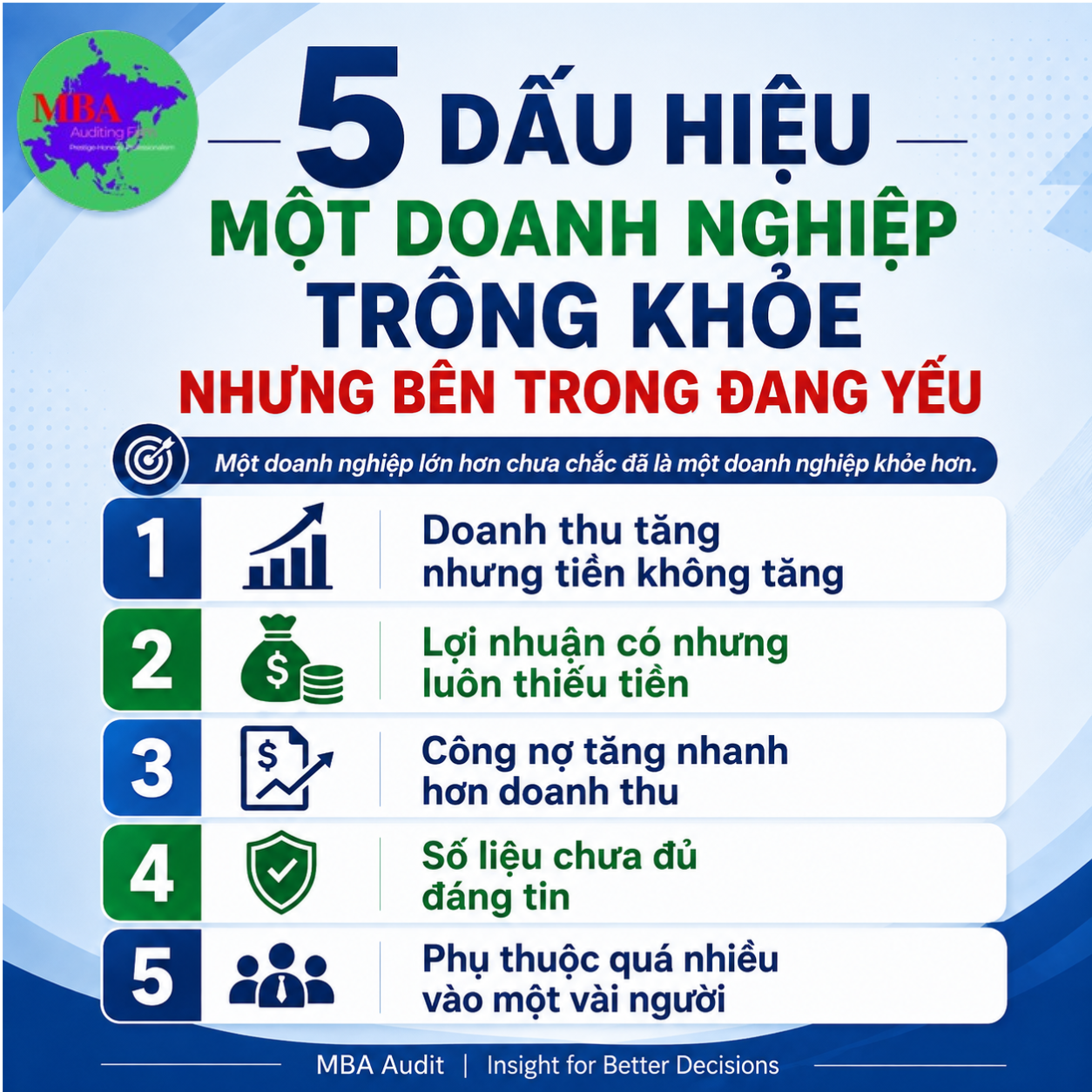
📊 5 SIGNS OF AN ENTERPRISE THAT LOOKS STRONG ON THE OUTSIDE BUT IS WEAK INSIDE
Some enterprises look very strong from the outside.
✅ Revenue is increasing.
✅ The customer base is growing.
✅ Headcount is expanding.
✅ Business scale is increasing.
However, when looking deeper into financial data and operational practices, the picture may be very different.
💡 A larger enterprise is not necessarily a stronger one.
Below are five signs that enterprises should pay close attention to.
1️⃣ Revenue is increasing, but cash is not
This is one of the most easily overlooked signals.
An enterprise may record strong revenue, but cash may still be tied up in:
- 📌 Accounts receivable;
- 📌 Inventory;
- 📌 Advances;
- 📌 Prepaid expenses;
- 📌 Or investments that have not yet generated cash flow.
If revenue increases by 30% but operating cash flow is weakening, the enterprise should ask:
Are we growing with real cash, or only with figures that have not yet been converted into cash?
2️⃣ Profitable on paper, but constantly short of cash
Reporting a profit in the financial statements does not mean the enterprise has cash in its bank account.
An enterprise may report a profit, yet still constantly have to:
- 💸 Take out short-term loans;
- ⏳ Request extended payment terms from suppliers;
- 👥 Delay salary payments;
- 💰 Inject additional capital;
- 🧾 Or scramble to find cash to pay taxes.
If this situation persists, the issue goes beyond accounting.
⚠️ It may be a sign that the quality of earnings is weakening.
The question that needs to be asked is:
Where exactly is our profit?
If that question cannot be answered with concrete data, the enterprise needs to take a closer look.
3️⃣ Accounts receivable are growing faster than revenue
📊 Revenue increased by 20%.
📌 But accounts receivable increased by 60%.
At first glance, the enterprise appears to be growing.
But the reality may be:
- ⚠️ Credit policies are too lenient;
- ⚠️ Customers are paying slowly;
- ⚠️ Customer quality is deteriorating;
- ⚠️ The sales team is driving revenue but paying insufficient attention to collectability;
- ⚠️ Or the enterprise is effectively using its own capital to finance its customers.
An enterprise can generate high sales but still face difficulties if it fails to collect payments on time.
Therefore, do not simply ask:
“How much did we sell this month?”
Also ask:
“How much of that has actually been converted into cash?”
4️⃣ You do not truly trust your own enterprise’s data
This is a significant warning sign.
If, before making a major decision, you often have to ask:
“Are you sure about this figure?”
“Is this accurate?”
“Can accounting please check this again?”
Or if you have to wait several days just to obtain a reasonably reliable figure, the issue is not simply delayed reporting.
🔎 It indicates that the data system has not kept pace with management needs.
When the enterprise is still small, this may not create major consequences.
But as scale increases:
A decision based on unreliable data can be far more costly than the cost of building a good system
from the beginning.
5️⃣ The enterprise is overly dependent on a few individuals
Some enterprises operate very well because of:
- 👤 An exceptionally capable chief accountant;
- 👤 A finance employee who knows everything;
- 👤 A tax officer who keeps all the records;
- 👤 Or the business owner, who is the only person who truly understands how cash flow actually works.
This can create the impression that the system is functioning well.
But in reality:
⚠️ If the departure of one person causes the entire system to become unstable, it is not yet a strong system.
A healthy enterprise needs:
- 📌 Processes;
- 📌 Delegation of authority;
- 📌 Data;
- 📌 Records;
- 📌 Controls;
- 📌 And the ability to operate without being completely dependent on any single individual.
💡 A healthy enterprise is not measured by revenue alone
If we need to quickly assess the health of an enterprise, we would not only ask:
How much revenue did we generate?
We would also ask:
💰 Is cash actually coming in?
📊 Is profit being converted into cash?
🧾 What direction are receivables and payables moving in?
🔎 Are the figures reliable enough?
⚙️ Can the system continue operating if a key person is absent?
Sometimes, the most important signals are not found in the largest number on the report.
They lie in:
📌 The relationship between the numbers.
So, before asking:
“How much bigger is the enterprise this year?”
Perhaps you should also ask:
“How much healthier is the enterprise this year?”
✅ Conclusion
📈 Growth creates scale.
🛡️ Governance creates health.
A truly healthy enterprise is not only one with increasing revenue, but one with strong cash flow, quality earnings,
well-controlled receivables and payables, reliable data, and an operating system that does not depend on a few
individuals.
📌 Save these 5 questions for your next financial meeting
1️⃣ Is revenue increasing, but cash is not?
2️⃣ Is profit truly being converted into cash flow?
3️⃣ Are receivables growing faster than revenue?
4️⃣ Does management truly trust the current data?
5️⃣ Can the system operate smoothly if a key person is absent?
📞 If your enterprise wants to review its financial health, cash flow, receivables, payables and internal control system,
contact MBA Audit for tailored advice and appropriate assessment support.
MBA Audit | Insight for Better Decisions
We do not only help enterprises look at the numbers.
We help enterprises understand what is happening behind those numbers.
- Official: Increase in the Taxable Revenue Threshold for Household Business to VND 500 million Per Year (From January 1st, 2026)
- 💼 [NEW GUIDANCE] DETERMINING DEPRECIATION PERIOD FOR RENTED FACTORIES & BUILDINGS
- 📌 Do Intern Students Have to Pay Social Insurance from July 1, 2025?
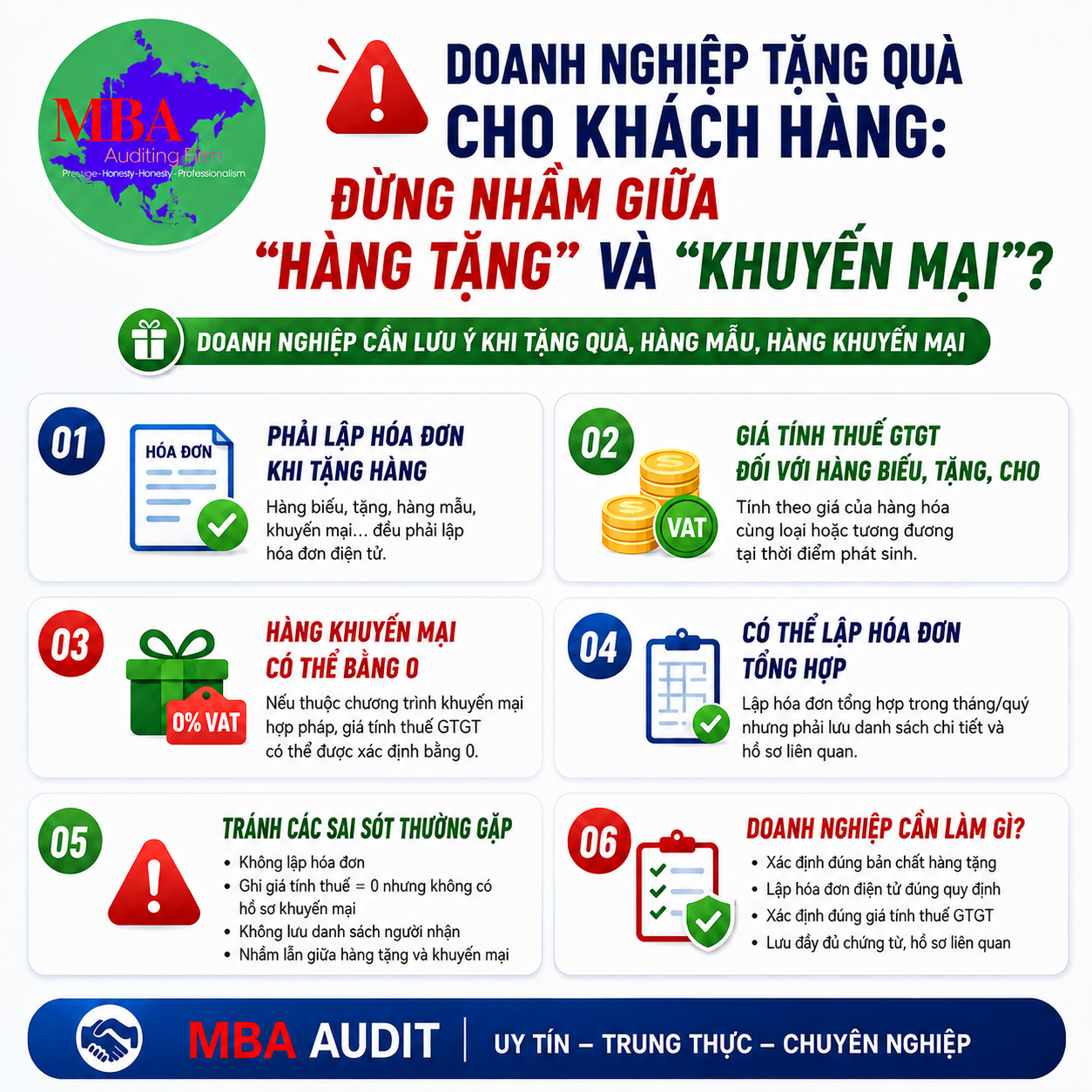
- ⚠️ ENTERPRISES GIVING GIFTS TO CUSTOMERS: DO NOT CONFUSE “GIFTS” WITH “PROMOTIONS”
- Circular 99/2025/TT-BTC – The End of the Accounting Era Where “All burdens fall on one person”